What Makes a Property Worth Coming Back To?

Updated: Oct 15
January 15, 2025 by Chip Fleming | Real Estate Development

Most commercial real estate buildings are unremarkable.
They serve their intended purpose, but too often fall short of what they could become. Despite enormous advances in development, design, and technology, one of real estate's greatest opportunities remains remarkably simple: creating places that respond to people's desire for connection, belonging, and meaningful experiences.
Instead of focusing on what truly draws people in, encourages them to stay, and gives them a reason to return, too many properties rely on surface-level enhancements that miss the mark.

THE COST OF MISSED POTENTIAL
Whether it’s a multifamily, office, retail, or industrial property, many owners — knowingly or unknowingly — accept ongoing revenue losses as just the cost of doing business. They hemorrhage money each month through rent discounts, concessions, turnover, downtime, and excessive marketing costs, all while trying to force a generic product onto a market that demands something better. In doing so, many risk falling into the trap of commoditization, where competition is driven primarily by pricing and discounts — a very costly game that very few business owners want to play.
Yet, the industry’s deep focus on cap rates and spreadsheets, often shaped by real estate publications and broker insights, overlooks a far more important question:
How do we create places where people genuinely want to be?
WHY TREND CHASING FALLS SHORT
Property owners looking to modernize often chase popular trends, adding fitness centers, pickleball courts, murals, or other amenities in an attempt to make their properties more attractive.
These investments can certainly be valuable, but their effectiveness depends on how well they serve the people who actually use the space. Too often, they're treated as isolated upgrades rather than part of a larger, cohesive vision, implemented without fully understanding who the residents or tenants are, how they live, and what they genuinely want from their environment.
A fitness center, for example, might seem like a worthwhile investment. But if it's filled with treadmills and elliptical machines while most prospective users prefer free weights and squat racks, it may become an underutilized amenity rather than a meaningful value driver.
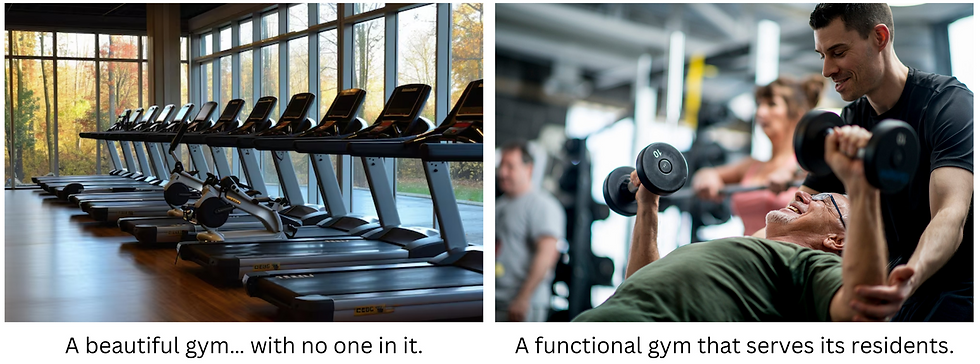
The same principle applies to other improvements. Without a deeper understanding of the people being served, even well-intended investments can miss the mark.
I've seen countless property owners rely on broad, generic customer personas — like “25-45-year-old professionals” — which fail to uncover what truly influences someone to choose, stay, and invest in a place.
I was recently in a meeting with a successful businessman who owns several multifamily properties. Frustrated by their performance, he was focused almost entirely on occupancy rates, viewing them as the ultimate measure of success.
What concerned me was the amount of money his properties were losing every month through rent discounts and concessions in an effort to maintain that occupancy. Rather than creating stronger reasons for residents to choose the properties, he was increasingly relying on price to compete.
During the same conversation, he proudly mentioned a recent investment: spending thousands of dollars to convert several basketball courts into pickleball courts.
When I asked what drove the decision, his answer was simple: "It's a fast-growing sport."
Yet he had no research into whether his residents actually wanted pickleball courts, how many might use them, or whether the investment would meaningfully influence leasing and retention. He had made a significant financial decision based on a trend without understanding whether it created value for the people living there.
To create spaces that stand out, property owners must dig deeper:
Who are your residents or tenants beyond their age and job title?
What are their aspirations, interests, and daily routines?
Where do they shop, dine, and spend their free time?
What types of experiences and environments make them feel at home?
What do they prioritize when it comes to spending their money?
FROM GENERIC PROPERTIES TO MEMORABLE DESTINATIONS
Understanding what people value is only the beginning. The greater opportunity is translating that insight into a property concept where the businesses, amenities, programming, design, and experiences work together with a clear purpose.
When those elements reinforce one another, a property can offer something beyond its individual features. It can develop a distinctive character, support meaningful interactions, and become part of the routines and relationships that connect people to a place.
For owners, that connection can strengthen demand, support retention, and contribute to long-term property value.
WHEN A PLACE COMES TO LIFE
Think about the places you love spending time in. Often, what makes them memorable is difficult to attribute to any single feature. It's the atmosphere, the unexpected discoveries, the sounds and activity around you, and the way the environment draws you from one experience to the next.

The most compelling destinations are designed with an understanding of how people actually experience a place. The relationship between indoor and outdoor spaces, the rhythm of activity, lighting, materials, landscaping, and even acoustics can influence how people move, interact, and spend their time. Thoughtful details create moments of curiosity and discovery, while intuitive layouts make exploration feel natural rather than prescribed.
But exceptional destinations aren't entirely scripted. Some of their most memorable qualities emerge from the people who use them: a lively outdoor café, an impromptu performance, a familiar gathering spot, or an unexpected conversation. Good design creates the conditions for these moments without trying to control every interaction.
The art is in creating an environment that feels intentional without feeling manufactured, where the experience is richer than the sum of its individual parts.